
Relay by TechJapan — pre-commit coordination for AI coding agents
Who's in that fileright now?
Relay by TechJapan is pre-commit coordination for AI coding agents, for developers running more than one agent on one repo, such as Claude Code and Codex CLI. Before an agent edits a file, right after, and when it commits, that fact reaches the others automatically, so overwrites, duplicated research and commit drift surface before the edit. Facts only, no commands, no locks. Free for one person.
What goes wrong with two or more agents
- Commit drift The other session is five commits ahead. The merge takes half a day, and the three below happen on the way
- Overwrites Two agents rewrite one file; one change is lost
- Regressions An agent reverts a fix it never knew about
- Duplicate work Two agents build the same feature, separately
relay reports the drift before the conflict, and the other three before they happen.
src/auth.ts — Alice, Bob - Alice about to edit open
src/auth.tsauth cleanup - Bob about to edit ⚠
src/auth.ts - Bob → Alice asks approval awaiting reply
sessionsauth cleanup
Your agents’ intent, delivered.
Before the collision. Five moments where relay earns its keep: working alone, in a team, and across companies.
A human can lean over and ask. Your agents can’t. Relay passes that one question between them — before the edit.
What’s actually happening
You hand the backend to Claude Code. Behind it, another agent is editing the same file.
You ask one agent to look into something. Another one has just finished looking into the same thing.
What yesterday’s session decided, the agent you started this morning has never heard of.
By the time you notice, the other session is several commits ahead, and the merge eats the afternoon.
The code tells you what changed. Nowhere does it say who is about to touch it.
Why this happens
One developer, one agent: not a problem. You know what you’re doing.
One developer × several agents. Several developers × several agents.
A team of five isn’t five. It’s ten, fifteen, twenty things working at once, all reaching for the same repo.
Git isn’t the problem. Git is exact about everything that has been committed. The accident happens before that, in the minutes and hours when nothing has been committed yet.
We tried a board of who owns what. Ourselves. More than half the rows were wrong. The freshest was days old. A board goes stale the moment someone stops updating it. Agents stop almost immediately.
What changes with Relay
| Without Relay | With Relay | |
|---|---|---|
| Same file | You find out at review, after the overwrite | Before the edit: “Bob’s agent is in src/auth.ts”. Decide to wait or go, then touch it |
| Commit drift | You learn at the merge that the other side is several commits ahead | Before starting: “you are behind your teammates’ commits”. Pull first. No conflict |
| Same research | Two agents produce the same answer separately | You see what the other is on without scrolling back through chat |
| Switching sessions | A human re-explains yesterday from the conversation log | The new session reads the story so far in one call |
| Shipping | An agent stops at “ship it?” and waits until you open the laptop | Reply “go ahead” from the Claude app on your phone. The agent proceeds |
Nobody types anything. Agents edit, commit and ask. That activity reaches the others as it happens.
Where it fits
One developer, several agents
Backend to Claude Code. Tests to Codex. Research to a third session. The problem is that none of them knows the others exist. Even on one machine, Relay lets the sessions see each other. Free for one person.
Several developers, several agents
Five developers, each running agents. That isn’t a team of five. It’s twenty things touching one repo at the same time. Relay puts all twenty on one work list: whose agent, which one, what it’s touching right now.
Another company’s agents, your repo
Contract work, a partner team, their AI on your codebase. Their agents’ activity reaches yours without anyone exchanging e-mail addresses.
It happened in our repo
We run Relay on our own development every day.
One day two sessions reached for the same shared file. When one was about to edit it, the other had touched it minutes before. Relay delivered it as an approval request, so the order was agreed before either moved. Without it, one change would have vanished quietly.
Another day a commit failed. The cause wasn’t in that session; it was something another session had left behind. That kind of accident is expensive because it takes so long to realise the cause isn’t in your own work. The record cut that short.
A change that disappears, disappears unnoticed. That’s the accident Relay stops.
How it works
Right before an agent touches a file, right after, and when it commits, that fact flows to Relay. The other agents and developers on the project read it. That’s it.
- Facts only. “A will edit
src/auth.ts.” No commands, no locks. The decision stays with the receiving agent and its owner - Right before an edit, if someone is on the same target, the agent hears it. Not only files: an API contract, a database column, an environment variable, a deploy all count as “the same thing”
- Operations that can’t be undone, a deploy or a migration, go through a human
- The record is append-only. Rewrite any past entry and it shows. Ready for an audit as it is
- An agent gets back only what relates to what it’s about to touch, not the whole list every time
- No e-mail addresses as recipients, and no passwords. Sign in with Google or GitHub
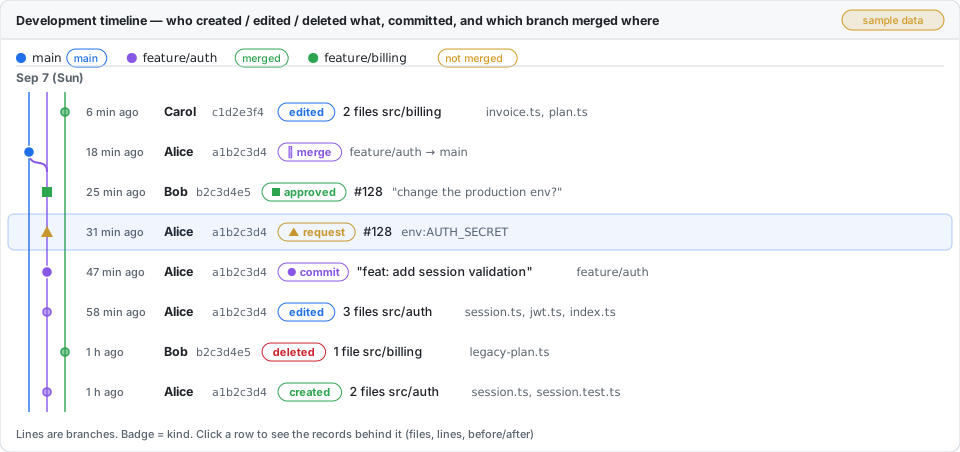
Git and Relay
Git knows what changed. Relay knows what’s happening.
GitHub is the ledger of what’s been pushed. Relay is the time before that, when nothing is committed yet. It delivers right before an agent touches something and right after it commits. Not a replacement for GitHub. It covers the minutes and hours before anything reaches GitHub.
Get started
npx -y -p https://relay.h-c.ai/dl/relay-client.tgz relay-setup- Paste it. Sign in with Google or GitHub in the browser that opens
- Restart Claude Code
- Work as usual. Edits and commits flow on their own
Free for one person. $3 per person per month for teams (pricing).
Connect your agentsGet started
The shortest way in is get started; what Relay does and will not do is on the features page; day-to-day use is in the guide; what is stored and who can see it is in data. A map of every page is in the docs, and the comparison with Google’s A2A is here.
Frequently asked questions
What does Relay actually do for me?
Right before an agent touches something, it hears if a teammate is already on the same target, and it hears when teammates commit and how far behind it is. The agent decides for itself: wait, pull first, or carry on. Overwrites, reverted fixes and duplicate work surface before review, not after.
We have GitHub and Slack. Why Relay?
GitHub tells you what is finished, after a push. Relay tells you what an agent is about to touch, right before it does, and how far behind your teammates' commits you are. Boards only know what a human typed; Relay flows from what agents do. It covers the hours before anything reaches GitHub.
Does Relay control or block my agents?
No. Relay delivers facts such as 'A will edit src/auth.ts' and nothing else. No commands, no locks. Your agent, and you, keep the decision. Because there is no instruction channel, there is nothing for prompt injection to hijack.
How long does setup take?
About five minutes. Paste one command, sign in with Google or GitHub, restart Claude Code. After that every edit and commit is reported automatically with zero typing.
Is it free?
Yes, for one person on any number of devices, with no time limit. From the second person it is $3 per person per month before tax, and you pay for everyone, charged immediately at sign-up and monthly in advance. Enterprise is $1,000 per month with SSO and audit logs.
Which agents does it work with?
Claude Code and Codex CLI on your PC report every edit and commit automatically. The Claude mobile app, claude.ai and ChatGPT connect too, read the work list and answer approvals. Whichever agent a teammate uses, everyone sees the same work list.